Accessibility & independence
Reading a menu. Taking a family photo. Access starts with everyday independence.
Accounts from veterans Donald Overton and Noah Currier show why multimodal AI should be designed with disabled people.
A technology's value can be as ordinary as reading the menu yourself or taking a picture when you choose. Those moments belong in a national discussion about AI access.
The need: more ways to do an ordinary task
Accessibility begins with the task a person wants to complete. People use different interfaces to read documents, understand images and take photographs. A service is useful when the person can choose a workable route and remain in control of the result.
Multimodal AI connects text, visual information and, in suitable systems, speech. Those capabilities give designers more ways to make an interaction accessible. The quality of the experience depends on more than the model: device controls, understandable feedback, privacy and a way to recover from an error all matter.
The broader need is therefore choice. A public service should accommodate different ways of seeing, hearing, moving, reading and communicating without assuming that one default interaction works for everyone.
Two accounts of everyday use
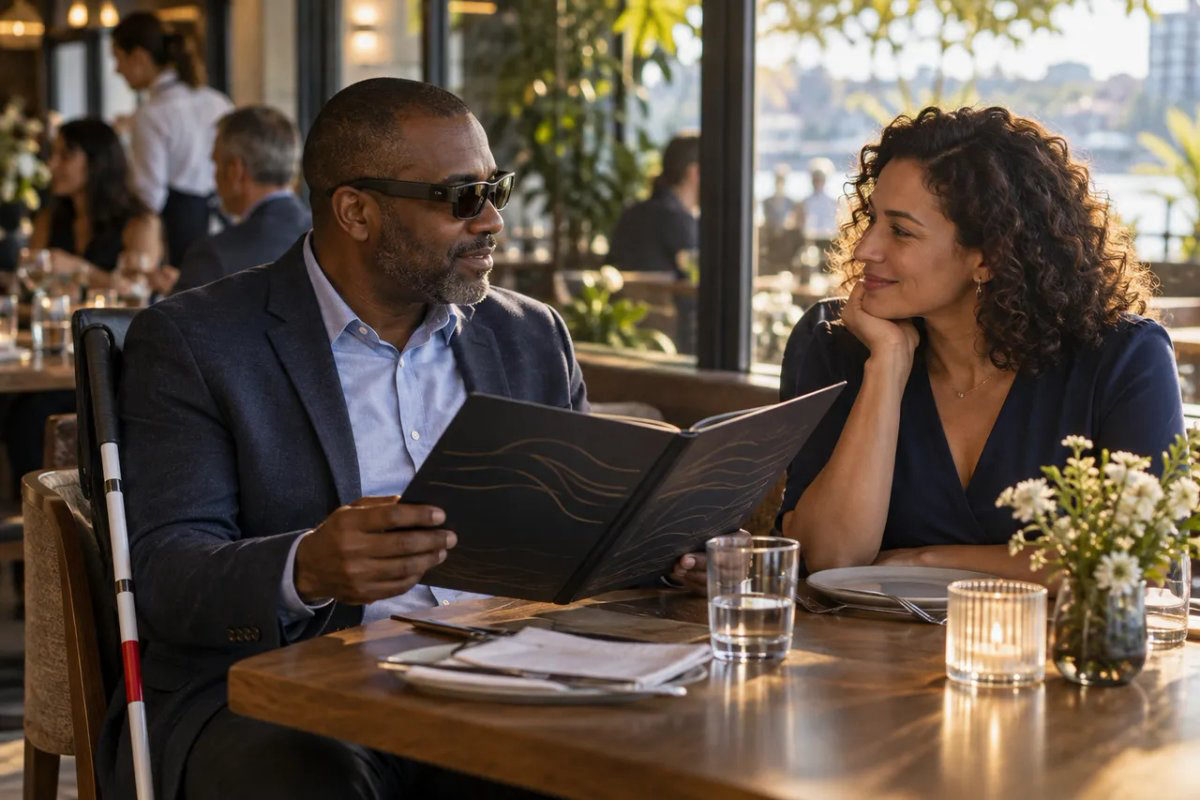
In a May 2026 account, Meta described Army veteran Donald Overton using AI glasses to read menus and obtain visual information. Marine Corps veteran and Oscar Mike Foundation founder Noah Currier described using voice-controlled glasses to take photographs, including a picture of his baby. The second example is a hands-free device feature; it should not be confused with proof of an AI model's reasoning ability. These are manufacturer-published accounts of individual experiences. Read Meta's accounts.
The design requirement is clear: a service needs to work for people who cannot comfortably use its default screen, keyboard or controls.
Design around a complete interaction
For document access, a person would provide material they are comfortable processing and ask for a summary or help locating a particular section. A useful application would preserve access to the source and make uncertainty visible. Names, dates, prices and other important details would need a way to be checked rather than silently normalized into a confident answer.
For an image, the user would specify what they want to know. Describing the overall scene and reading a small line of text are different tasks with different failure modes. The interface would let the person ask a follow-up question, receive an accessible response and decide whether to seek human assistance.
For creative or everyday communication, the person would choose between available controls instead of being required to speak or type. Captions, keyboard navigation, screen-reader support and understandable status messages would be part of the design. A feature that only works through one inaccessible control has not completed the task.
Evaluate with the people who would use it
Design sessions should include people with varied disabilities, devices and preferences. Participants would help identify what information they need to make a decision and what an error costs them in the context of that task.
Testing would include slow connections, unavailable services and incorrect descriptions. Users need a clear way to stop, correct or change the interaction. Camera and microphone access should be deliberate and visible, with understandable controls over the information supplied.
These choices would help distinguish an impressive demonstration from assistance that a person can use repeatedly and confidently.
Let users define the benefit
Disabled people should be paid participants in design and testing. Evaluation should examine whether a person can complete the task, how often descriptions are wrong, how easily errors can be corrected and what happens when the service is unavailable.
Reading an ordinary document and providing safety-critical navigation are different responsibilities. A successful document pilot would not establish that a model can safely guide someone through traffic.
The public goal is greater choice and independence. Mentioning these stories does not imply endorsement by the veterans, their organizations or Meta.
How Liberty will make accessibility part of a public foundation
LibertyGPT will offer accessible ways to interact, with alternatives to any single input or output method. Multimodal development will support work on images and documents; future voice models will add speech-based options after appropriate evaluation.
Liberty OSS will give accessibility researchers and application developers models they can adapt to specialized interfaces. Where hardware and performance permit, local processing will create another deployment choice. That will still require usable devices, careful testing and controls over personal information.
the program’s learning and support programs will help people understand those options and find assistance when needed. Liberty will contribute an adaptable technical foundation and a public-service commitment to inclusion, so accessibility can be considered throughout development rather than left to individual users to solve.