Search could not load. Reopen to retry, or browse topics.
THE LIBERTY AI MODEL PORTFOLIO
American AI models. A lasting public foundation.
American Super Intelligence will create, train and improve Liberty AI models for the American people. Liberty Frontier will power the LibertyGPT public assistant. Liberty OSS will provide open-source releases, while Liberty Gov and Liberty Sentinel will support separately authorized missions.
Concept illustration of model development.
HOSTED FLAGSHIP MODELS
Liberty Frontier.
The flagship hosted family behind LibertyGPT, built for advanced reasoning, coding, research and multimodal work. Government stewardship will preserve control over its development and operation.
Flagship intelligence through LibertyGPT
2+ trillion total parameters as a development target
Liberty Frontier Code specialist development track
Open models for people, universities and American businesses to run, inspect and adapt. Public releases will provide a foundation for learning, research and independent applications.
Nano, Small, Medium and Large size tiers
Liberty OSS Code variants for software work
Explicit open-source licenses and documented releases
Models customized for agency work using authorized information. Government teams will direct model training, evaluate them against real tasks and control access.
Agency knowledge, research and administrative work
Custom model training and connections to approved sources
Models developed for defense and national-security missions. Each variant will operate within its authorized environment, with mission owners responsible for data and release decisions.
Mission-specific model training and evaluation
Separately controlled access and infrastructure
Restricted or classified operation where authorized
Liberty AI is a proposed model portfolio. These models have not been released. Public access will use LibertyGPT and public OSS releases; protected agency and mission information will stay in separately authorized systems.
THE PUBLIC ASSISTANT
LibertyGPT.
LibertyGPT will be the public chatbot and assistant for every American citizen. People will ask questions, learn, write and build software without installing or operating a model.
Liberty Frontier will provide flagship intelligence. The service will also use smaller Liberty models for suitable tasks, with clear access to advanced capabilities. Model routing will be evaluated for quality, response time and national demand.
Search, approved document retrieval and controlled code execution will extend the assistant. These are service tools with their own permissions and integrations.
Liberty OSS will give developers and institutions models to run and adapt themselves. Each release will document its license, included code and development information, tested capabilities and limitations. Open-source claims must match the assets and rights delivered. The Commerce Department’s NTIA report on widely available model weights identifies benefits for research, competition and confidentiality alongside safety, security, privacy and civil-rights risks. Liberty OSS release decisions will evaluate both sides rather than assume every model should be released the same way.
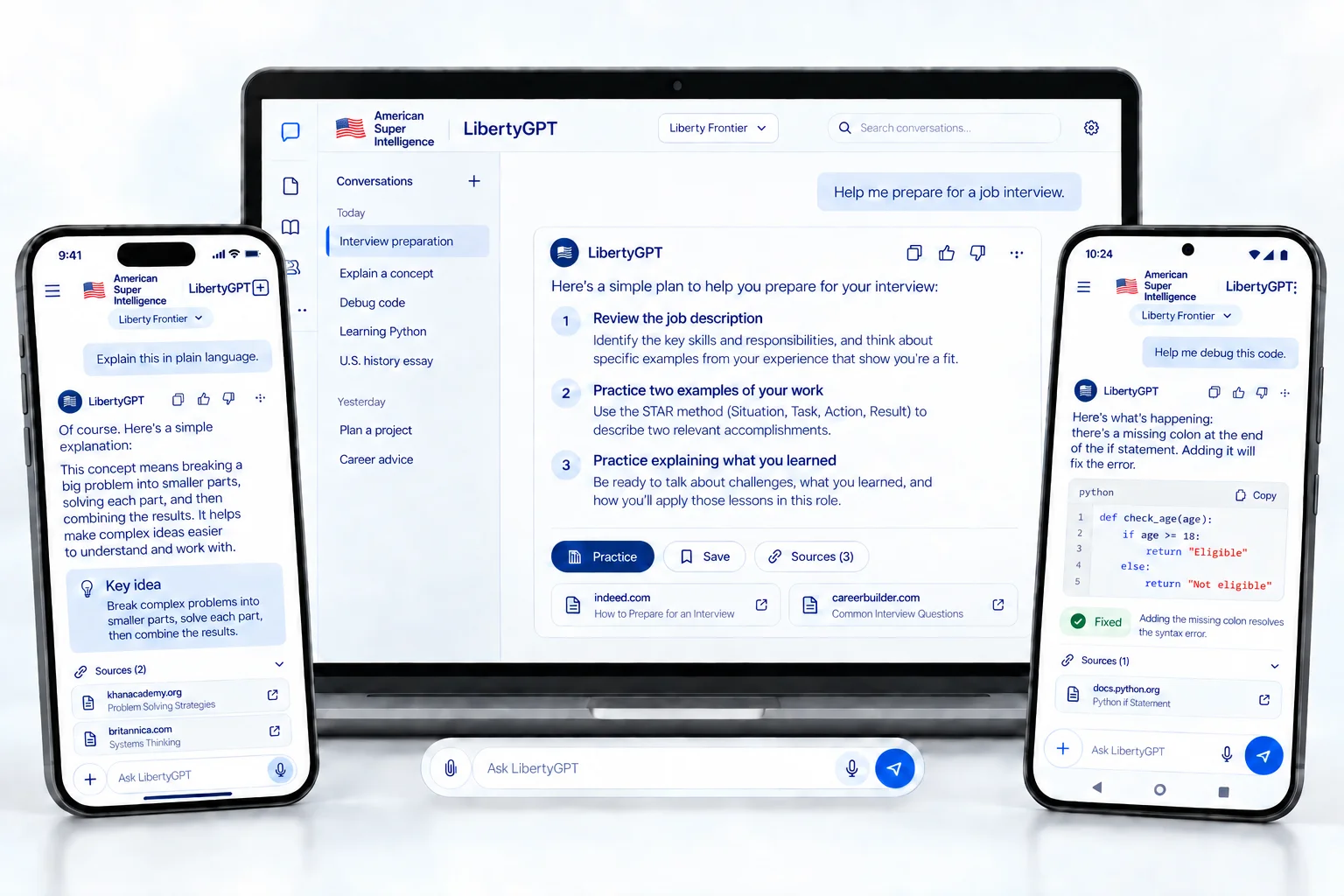
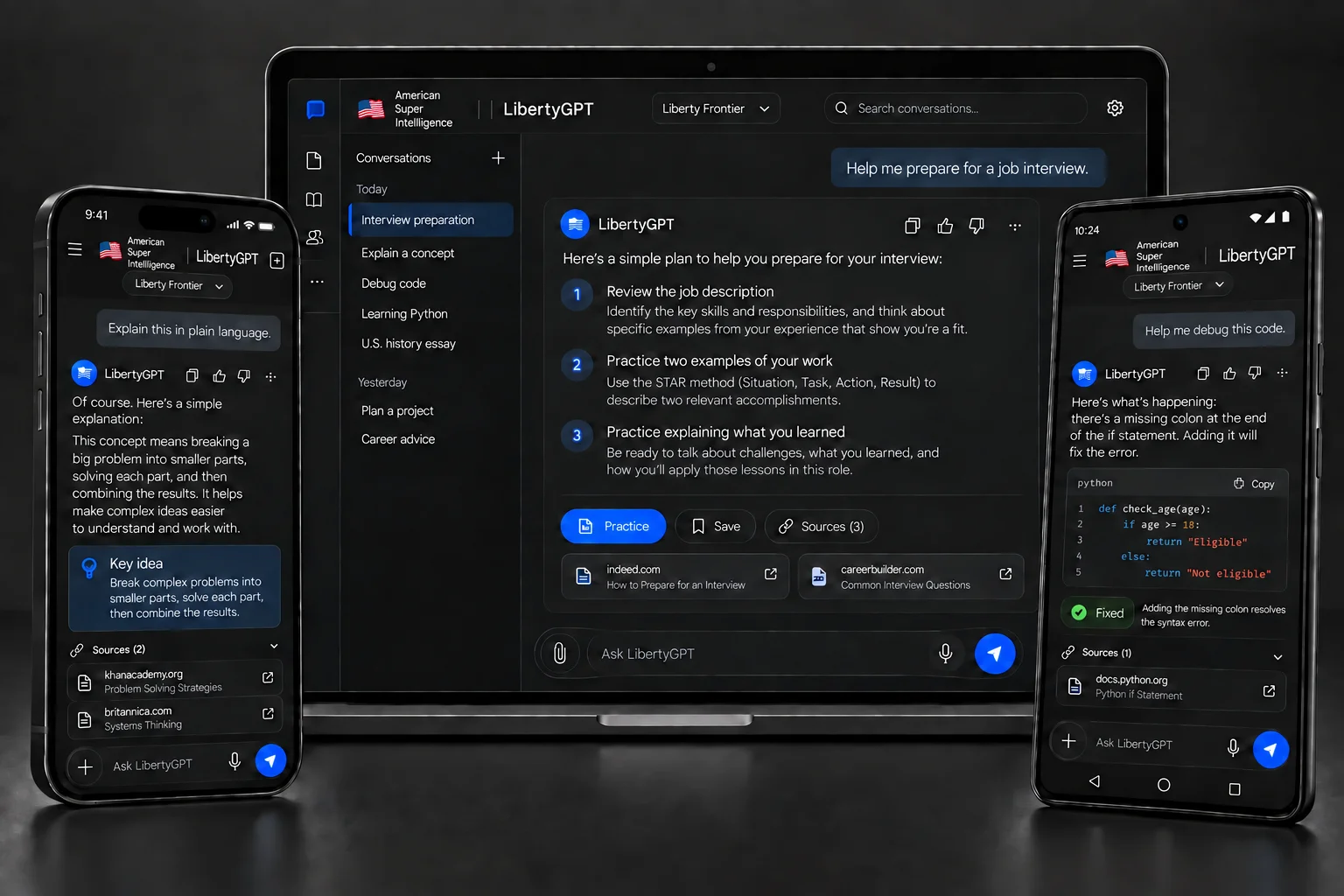
LibertyGPT will bring learning, writing and coding into one familiar conversation across the web, iOS and Android. Explore the proposed interface in light and dark modes.
Desktop web · iOS · Android · Light mode.One LibertyGPT experience, adapted to each platform. View full-size rendering
Desktop web · iOS · Android · Dark mode.One LibertyGPT experience, adapted to each platform. View full-size rendering
AI-generated interface renderings for the American Super Intelligence proposal. Conversations and controls are illustrative. LibertyGPT has not launched; final designs, model availability and app features will be established through development and evaluation.
LIBERTY FRONTIER · THE HOSTED FLAGSHIP
Frontier intelligence. Public purpose.
Liberty Frontier will power LibertyGPT’s most demanding reasoning, coding, research and multimodal tasks. The development program will target architectures exceeding two trillion total parameters, with design choices guided by measured capability, reliability and operating efficiency.
This is a development target, not a trained model or a claim of demonstrated performance. Total and active parameters, architecture, model-training data, computing platforms and delivery milestones remain to be defined. Parameter count alone does not establish frontier capability or super intelligence.
Frontier research will contribute to the program’s longer-term ambition: an American public foundation for the path toward super intelligence. Progress will depend on demonstrated advances in reasoning, discovery and useful work, alongside independent safety evaluation. Explore the long-term vision
HOSTED ACCESS, PUBLIC STEWARDSHIP
Retain control. Build for continuity.
Government will retain the rights, model-development knowledge and operating capability needed to sustain Frontier and change suppliers. Hosting describes how people will access the model; it does not assign ownership to a private provider.
Frontier’s release policy will explicitly address weights, code, research assets and public rights. Liberty OSS will carry the portfolio’s documented open-source release commitment. Gov and Sentinel variants will use suitable Liberty technology under their own authorized data and operating controls.
LIBERTY OSS · FOUR PROPOSED SIZE TIERS
From local tools to demanding work.
Nano, Small, Medium and Large will serve different computing and task needs. Smaller releases will come first. These size ranges guide planning; architecture and performance will be established through development.
Model tier
Illustrative size
Intended use
Liberty OSS Nano
Illustrative: 1–4B dense, or ~6B total / ~1B active MoE
Focused assistance, learning exercises and selected local or offline tasks on suitable devices.
Liberty OSS Small
Illustrative: 7–14B dense
Everyday assistance, introductory coding and document tasks, with visual support where developed and evaluated.
Liberty OSS Medium
Illustrative: 20–40B total; dense or sparse
More demanding coding, document reasoning and specialist applications for developers and institutions.
Liberty OSS Large
Illustrative: 70–150B total; active size architecture-dependent
Complex reasoning, software engineering and shared services, evaluated against leading U.S.-developed models.
B means billion parameters. A dense model uses its parameters together; a mixture-of-experts model activates a portion for each token. Total and active counts describe different things. Device requirements, speed and capability must be measured for each release.
These are Liberty OSS sizes. Liberty Frontier is a separate hosted family with a larger development target; Gov and Sentinel describe mission requirements, not parameter tiers. Performance must be demonstrated for every release.
WHAT THE MODELS WILL DO
Understand. Build. Create. Communicate.
The portfolio separates hosted and downloadable access from government and protected mission requirements. Sizes and capabilities describe individual releases. One family name does not mean one model must perform every task.
CORE DEVELOPMENT DIRECTION
Liberty OSS Code & Frontier Code
Coding will be a core capability across the portfolio. Liberty OSS Code variants will support local development and downloadable tools. Liberty Frontier Code will be a hosted specialist track for complex repository work, testing, debugging and software modernization.
Specialist releases will need to demonstrate gains over the general models. Evaluation will include complete development tasks and code quality.
Development-tool integrations will keep code execution and repository changes under the user’s control.
CORE DEVELOPMENT DIRECTION
Multimodal understanding
Models will connect text and code with visual information. A learner will ask about a diagram; an engineer will examine a chart or document alongside a question.
Supported inputs will vary by release. Understanding an image and generating one are separate capabilities.
FUTURE DEVELOPMENT TRACK
Image generation
Future image models will support creating and revising illustrations, teaching materials and design concepts through LibertyGPT and approved applications. Development will include model-training data rights, provenance and evaluation of generated work.
FUTURE DEVELOPMENT TRACK
Voice and audio
Future voice models will add speech recognition, spoken responses and conversation to LibertyGPT and approved applications. Evaluation will address languages, accents, response time, consent and accessible text alternatives.
The first service and smaller OSS releases will establish access while Frontier development advances through staged evaluation. Coding, multimodal understanding and future image and voice capabilities will have explicit model-training, funding and release decisions. LibertyGPT will connect released capabilities in one interface.
COMPARE WITH LEADING U.S.-DEVELOPED MODELS
Set a high bar. Measure the result.
Liberty models will be evaluated against appropriate U.S.-developed open and commercial models. Tests will compare the same tasks, tools and resource budgets, with results published alongside limitations.
Useful work
Measure reasoning, code correctness, document understanding and task completion. Check factual support and performance on unfamiliar problems.
Practical access
Measure reliability, accessibility, response time and full cost per successful task. A model must work for its intended users and operating environment.
Independent evidence
Record exact model versions and evaluation settings. Publish weaknesses as well as strengths and update comparisons before release decisions.
U.S. model scale references
These examples describe published model sizes, not demonstrated Liberty performance or selected suppliers. They are not a ranking of current frontier capability.
Arcee Trinity Nano Preview: 6B total / 1B active parameters; an experimental small mixture-of-experts reference.
NVIDIA Nemotron 3 Super: 120B total / 12B active parameters; a larger mixture-of-experts reference.
Arcee Trinity Large Preview: approximately 398B total / 13B active parameters; a reference for larger-scale research.
Sources checked September 17, 2026. Commercial comparisons will use U.S.-developed systems with verified provenance and evaluation access. A comparison does not imply a partnership, a shared license or a decision to use that model as a base.
MODEL CREATION AND TRAINING
Build models. Retain the knowledge.
American Super Intelligence will fund the science and engineering needed to develop and sustain the portfolio. Teams will train new models and adapt suitable foundations, with public rights established before development. Evaluation will follow defined use contexts and lifecycle risks, drawing on the NIST AI Risk Management Framework and its generative-AI profile rather than relying on a single benchmark.
01
Prepare
Define the task, establish data rights and assemble model-training data and evaluation datasets.
02
Train the model
Develop or adapt the model through pretraining, post-training and other justified methods.
03
Evaluate
Test useful gains, errors, reasoning, reliability and resource requirements.
04
Release and maintain
Document the model, deliver the authorized assets and prepare the people who will operate and improve it.
Government employees and contractors will retain the rights, records and practical knowledge required to continue the work. Explore delivery responsibilities