
College & careers
From an ASU classroom to an engineering internship: AI learning gets practical.
Sanskar Srivastava’s internship and ASU’s wider literacy effort show why access needs a pathway into practical skills.
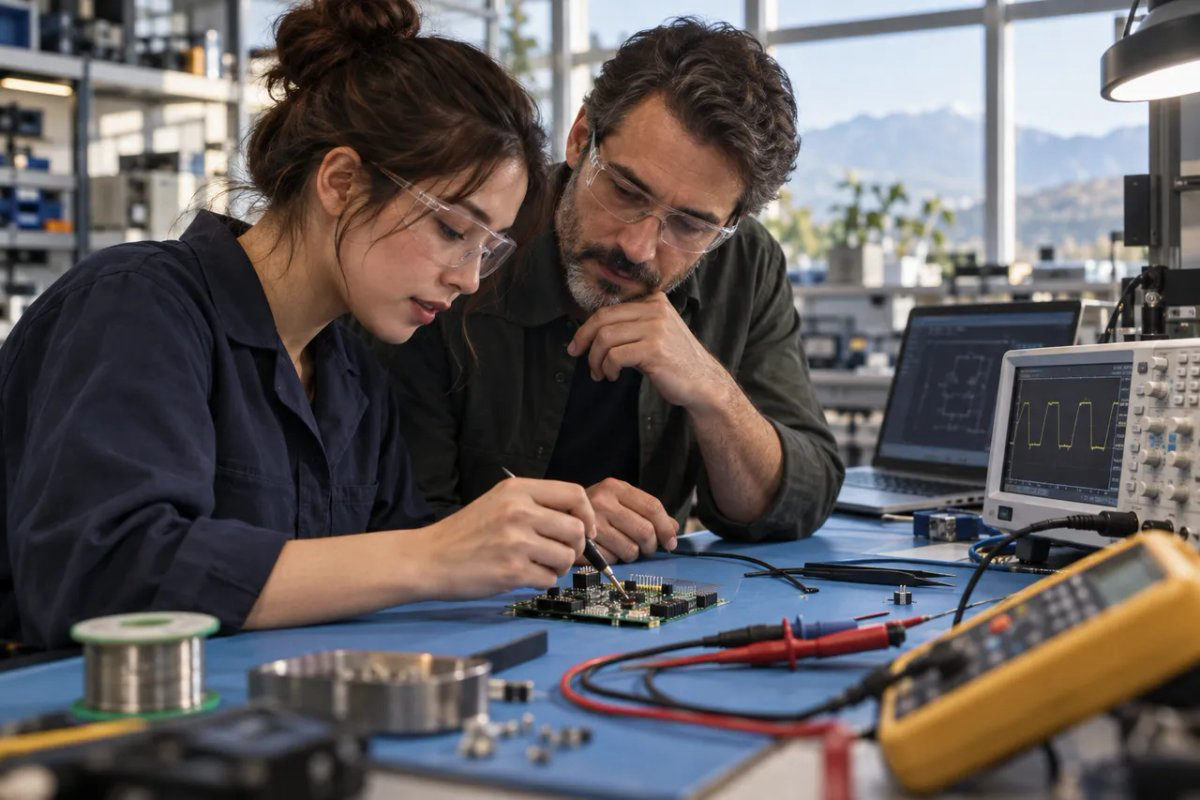
For Sanskar Srivastava, learning AI connects to engineering work at Microchip Technology. His September 2026 ASU profile offers one concrete example of what a pathway from study to practice can look like. the program’s proposed education pathway would extend access to that kind of practical learning. Read his story.
The need: a route from using AI to understanding it
Being able to ask a chatbot a question is a useful beginning. Applying AI in engineering, research or another profession requires more: defining the problem, selecting appropriate information, checking the output and explaining the decision that follows.
Students need a progression between those levels. A learning pathway can start with asking for a different explanation, continue with inspecting a small program and build toward designing an experiment that compares two approaches. Each step should build on skills they can demonstrate rather than on the sophistication of the tool they used.
The same need extends beyond a university. A working adult preparing for a new role, a community-college student and a recent graduate all need ways to keep practicing. Access and instruction need to continue across those transitions.
ASU connects AI literacy with academic disciplines
On August 28, 2026, Arizona State University reported that every college and school would offer AI literacy courses that fall, with learning connected to students’ disciplines. The university also described a summer effort to help faculty redesign assessment for an environment in which AI can complete many conventional assignments. This is an institutional account of its approach, not evidence that every student has completed training or improved their learning. Read ASU’s report.
A September 9 ASU profile makes the connection to work tangible: graduate student Sanskar Srivastava is applying AI and machine-learning skills during an engineering internship at Microchip Technology. One student’s experience cannot establish a national employment trend, but it illustrates a pathway worth making easier to enter. Read the student’s story.
Learning through work that can be checked
In an engineering exercise, a student would use an assistant to draft a script that organizes measurements from a lab exercise. The important work would include checking units, inspecting missing values, comparing calculations with a known example and explaining every transformation. A second assignment would ask the student to modify the script without generated instructions.
A humanities student would use a different exercise: compare arguments in assigned texts, verify quotations and write an interpretation that distinguishes evidence from speculation. A business student would examine a fictional operating dataset, test assumptions and explain why a recommendation changes when those assumptions change.
These examples share a learning pattern. Define the question, use assistance, verify the work and demonstrate independent understanding. That pattern makes AI literacy relevant across disciplines while preserving the standards of each subject.
Make the next step visible
Advanced pathways would build toward data preparation, model evaluation, adaptation and distributed systems. Students would need supervised environments, reproducible examples and instructors who can explain failures as well as successes.
A portfolio would be strongest when it includes the original problem, tested work, limitations and an account of the learner’s contribution. Employers and research supervisors would then have something concrete to discuss. Certificates alone would provide less information than a project the learner can defend and maintain.
Access should lead to demonstrated skill
A learning pilot should ask students to solve a new problem after assistance is removed. It would track who participates, who cannot access the tools and how much support instructors need. Career pathways would need actual employer and education partners; an AI course alone cannot promise a job.
These are proposed American Super Intelligence contributions, not an announced relationship with ASU or Microchip. The national opportunity is to make tools, practice and expert guidance available along more routes into skilled work.
How Liberty will connect access with a lasting learning pathway
LibertyGPT will give learners a place to begin and keep practicing outside a particular course or employer account. Liberty OSS will extend that opportunity into labs where students can inspect, run and adapt a model. Liberty OSS Code will support local software exercises, while Liberty Frontier Code will be the hosted specialist track for more demanding projects. Evaluated multimodal capabilities will connect questions to technical documents and diagrams.
the program’s education program will supply reusable materials and instructor preparation across those stages. Research compute will remain a separate, defined allocation; everyday access will not imply unlimited model-training capacity.
Together, the services and models will give institutions more control over how they teach and learners more continuity as their needs develop. The intended result is a progression from asking for help to creating, testing and sustaining useful work—a progression that schools and employers will evaluate through demonstrated skills.
That progression also prepares the people who could help build America’s path toward super intelligence: researchers, engineers and practitioners who can question, improve and responsibly use increasingly capable models.