
Manufacturing & industry
PepsiCo is testing factory changes before moving equipment.
A January 2026 U.S. digital-twin initiative shows how AI can help engineering teams examine changes before construction.
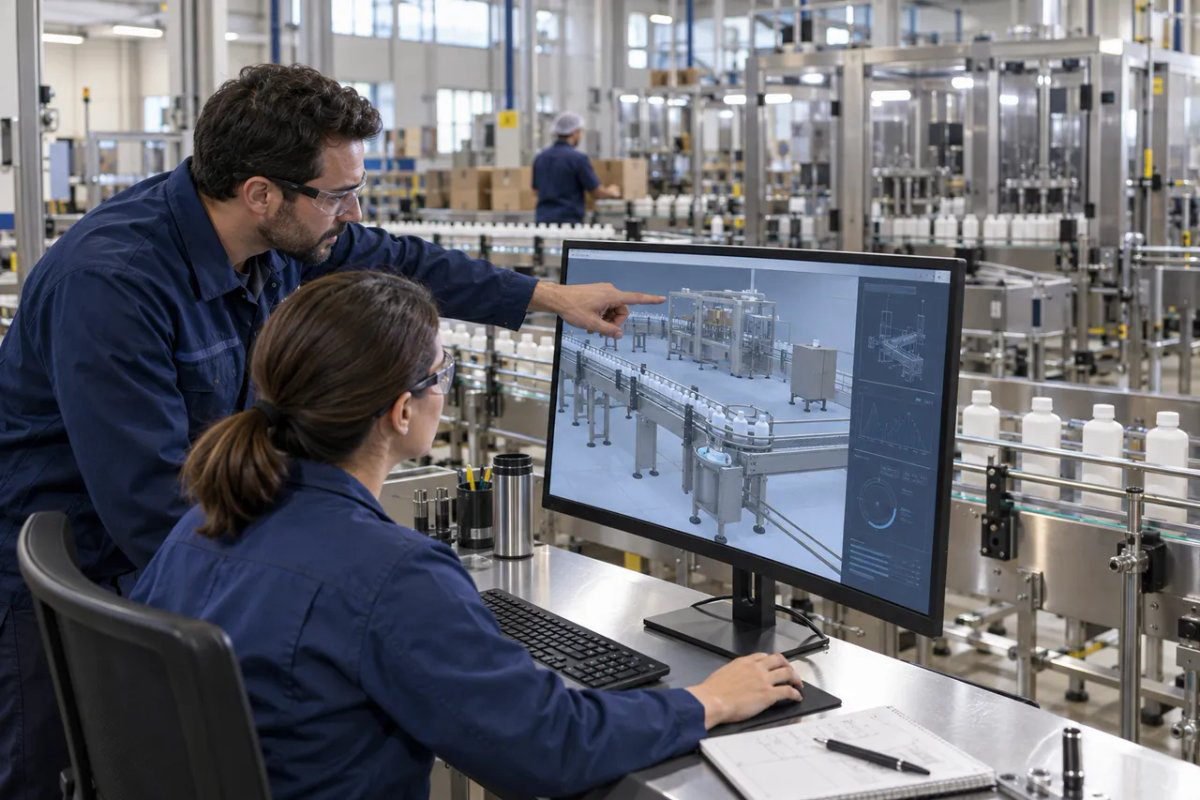
Moving a conveyor on a screen is easier to undo than moving one on a factory floor. That is part of the appeal of a digital twin: an engineering representation in which teams can examine changes before committing physical work.
The need: investigate a change before committing physical work
A factory or warehouse improvement depends on how several systems interact. Equipment layout, material flow, maintenance, software and the people doing the work all affect whether a proposed change is useful.
Digital analysis gives an engineering team a place to examine assumptions before making a physical commitment. That analysis still needs accurate data and a model of the process that reflects operating conditions. A convincing picture of a facility is only the beginning of that work.
AI’s supporting role is concrete: prepare information, help write analysis code and check the software used in an engineering study. The broader need is an engineering process that a team can understand, test and maintain—not simply a more impressive simulation screen.
PepsiCo puts digital twins to work
On January 6, 2026, PepsiCo announced a collaboration with Siemens and NVIDIA, with early U.S. pilots using digital twins and AI to study manufacturing and warehouse operations. Its announcement described simulating facility changes and reported a 20% throughput increase in an initial deployment. That figure is a company-reported result from that deployment, not a forecast for other factories. Read PepsiCo’s announcement.
More American engineering teams need access to these skills and computational tools, including suppliers that lack the resources of a global manufacturer. American Super Intelligence would support that access through open models, technical education and defined research allocations.
Practical uses around the engineering workflow
A maintenance team would begin by locating relevant information in approved manuals and historical records. A document tool would return the source passage and its version, then help prepare questions for a qualified reviewer. It would not turn a plausible explanation into an authorized maintenance instruction.
An analyst studying delays would use coding assistance to prepare a script that organizes a permitted dataset. The team would examine missing records, reproduce the calculation and compare possible explanations with operating experience. A generated chart would be useful only if the underlying work withstands those checks.
For a proposed layout change, engineers would use established simulation tools and validated process data. AI would assist with code, documentation and comparison of outputs. The team would keep assumptions visible and test whether the simulation predicts known behavior before relying on a new scenario.
Help people work across disciplines
A useful project also needs communication between software developers, process engineers, technicians and operations staff. Assistance would help draft a change record or explain a technical result to a different team, with the responsible specialists checking the meaning.
Role-specific instruction would teach each group where the model fits and when to stop. Teams would practice detecting a wrong unit, an outdated procedure or a conclusion that depends on missing information. These habits would be part of preparing people to use the system in real work.
The rest of the system still matters
Language models do not supply an accurate digital twin by themselves. The work also needs engineering data, simulation tools, qualified people and validation against the physical process. Equipment controls, safety systems and production decisions require their own authorization and testing.
An program-supported manufacturing pilot should begin with an offline study of one defined bottleneck. Compare predicted and observed behavior, record engineering hours, and track the cost of preparing data and correcting model output. Count improvements only when the operating evidence supports them.
PepsiCo, Siemens and NVIDIA are examples in the reporting, not established American Super Intelligence partners. The proposed public contribution is to broaden access to adaptable intelligence, education and research capacity that American industry would build upon.
How Liberty will strengthen the engineering foundation
Liberty OSS will give American manufacturers and software companies models they can adapt inside approved environments. Coding variants will support engineering software and tests; evaluated multimodal variants will help teams work with diagrams and technical documents. Proprietary operating data will stay under the organization’s chosen controls.
LibertyGPT will also provide an entry point for general learning and nonsensitive work, with Frontier supporting demanding reasoning and coding as those capabilities are released. More demanding industrial applications will need their own computing, integration and support. the program’s research allocations and advanced engineering education will provide defined routes for institutions contributing to those methods.
Liberty will connect reusable models with the engineering skills needed to apply them. More teams will have a starting point for developing and examining useful tools, while engineering evidence will determine whether those tools improve a real operation.
the program’s path toward super intelligence carries that ambition further: help American engineers explore harder design problems as models advance, with testing and physical evidence continuing to guide every operational decision.