
Agriculture & rural life
Rachael and Don Sharp use AI to tackle farm-office paperwork.
A South Carolina farm family is using AI for paperwork—and asking who helps the farmers without a technical guide.
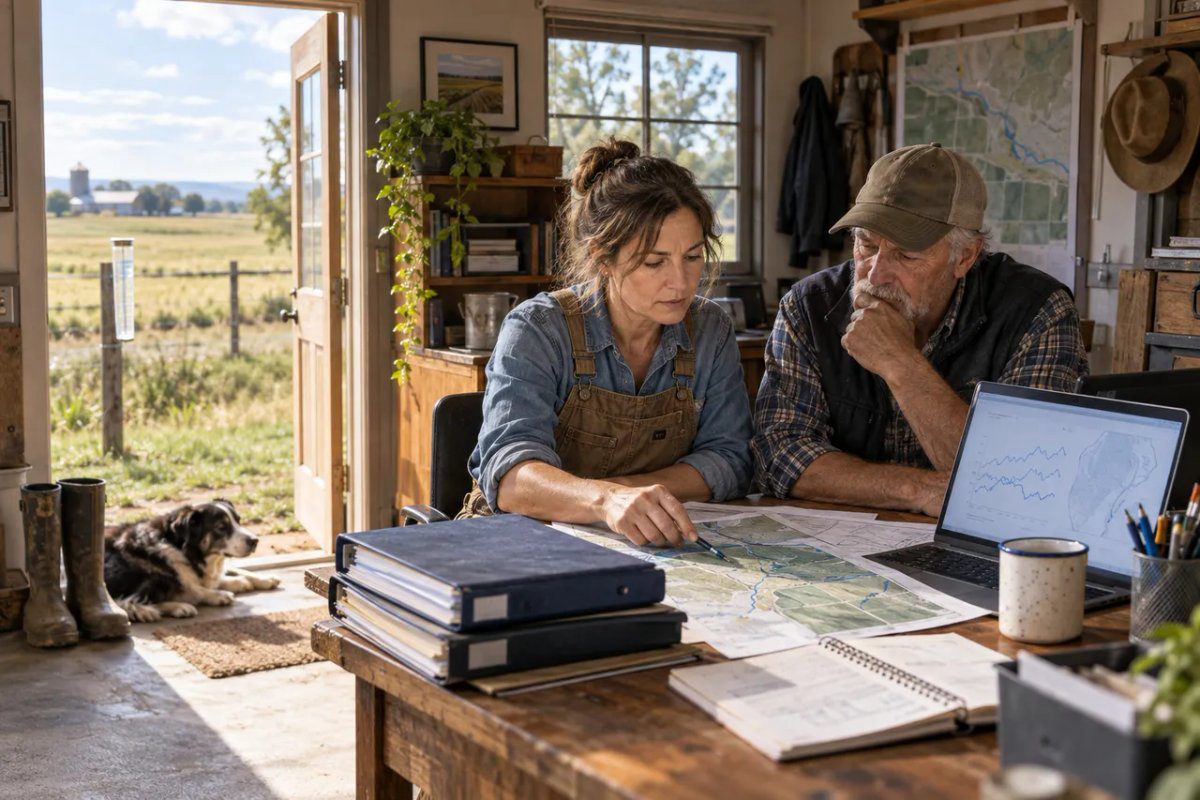
Some of the most consequential work on a farm happens after the field work: organizing records, preparing reports and checking that the paperwork is right.
The need: make the information side of farming easier to manage
A farm is also a business with records, equipment information, purchasing decisions and reporting work. A useful digital tool would help connect that information to a task the operator needs to complete, without losing the original evidence or the judgment behind the decision.
Farm-office work offers concrete starting points: finding a passage in a manual, organizing notes for an adviser or checking a draft report for missing fields. These are smaller tasks with a clear output that a person can review.
Access also includes knowing how to use the tool. An operator should have a practical route into education and support that fits their work, including when connectivity is limited or the information begins on paper.
A family farm in Allendale
In a June 26, 2026 Farm Progress report, Rachael Sharp and her father, Don C. Sharp III, described using AI in their South Carolina farm business. Rachael uses it to help prepare water-use reports and organize operational information, then reviews and corrects the output. She also raised a concern about older farmers who lack someone to help them navigate digital systems. These are reported experiences from one farm, not a general estimate of agricultural productivity. Read Farm Progress's report.
That concern goes directly to the public mission: a powerful tool is less useful if a person cannot learn to use it or connect it to the work in front of them.
Begin with a specific office task
For record preparation, an operator would work from copies of permitted records and ask the tool to organize them into a draft. Dates, units and missing entries would remain visible. Before anything is submitted, the person responsible would compare the draft with the originals and resolve uncertainties.
For equipment knowledge, a tool would help locate passages in an approved manual and prepare questions for a qualified technician. The value would be easier access to the relevant information. Actual maintenance procedures and physical work would follow the manufacturer’s instructions and the operator’s established controls.
For business communication, assistance would help draft a supplier question, explain a public notice or organize a list of documents for a meeting. A producer would check the meaning and decide what to share. Private financial and operating information would need an approved environment rather than an assumption that any public chat is appropriate.
Make learning fit the work
A useful agricultural lesson would use a familiar task and a small, reviewable example. The instructor would show how to recognize an invented number, preserve a source document and correct an output before it enters a workflow.
Local educators and extension specialists would help select appropriate material. Software designed for intermittent connectivity would also need testing on actual devices and a clear way to synchronize or reconcile records. A tool is only useful if it fits the conditions in which the operator must use it.
Agriculture also needs specialized systems
John Deere's May 2026 See & Spray update offers a separate example of task-specific machine learning in equipment. Its announcement distinguishes current enhancements from a planned 2027 feature. Public assistants would complement specialized agricultural technology, not replace machinery, agronomic expertise or its control systems. Explore the supplier's See & Spray system.
An American Super Intelligence agricultural pilot should start with administrative assistance and reviewed extension information. It should measure errors, correction time, source accuracy and the ability to use the system with limited connectivity. Treatment recommendations and equipment control would require separate evaluation.
No partnership with the Sharp family or John Deere is implied. The opportunity is to make practical AI support easier to reach across rural America.
How Liberty will make practical farm support easier to reach
LibertyGPT will provide an entry point for general questions, drafting and learning. Liberty OSS will give American developers and agricultural institutions models to adapt into specific farm-office applications, including local tools where hardware and performance permit.
That distinction matters for data control. A producer can use the public service for suitable information and choose an approved private application for business records. Open model access will support independent development without requiring the farm to publish its own information.
the program’s education program will connect those tools with practical instruction through qualified educators. Liberty will combine access, adaptable technology and human support so farmers can turn an administrative need into a tool they understand and can check.