
Libraries & community
Kim Grotewold’s AI work starts with people, questions and a library.
A Texas librarian’s approach shows how public access can include research skills and local human support.
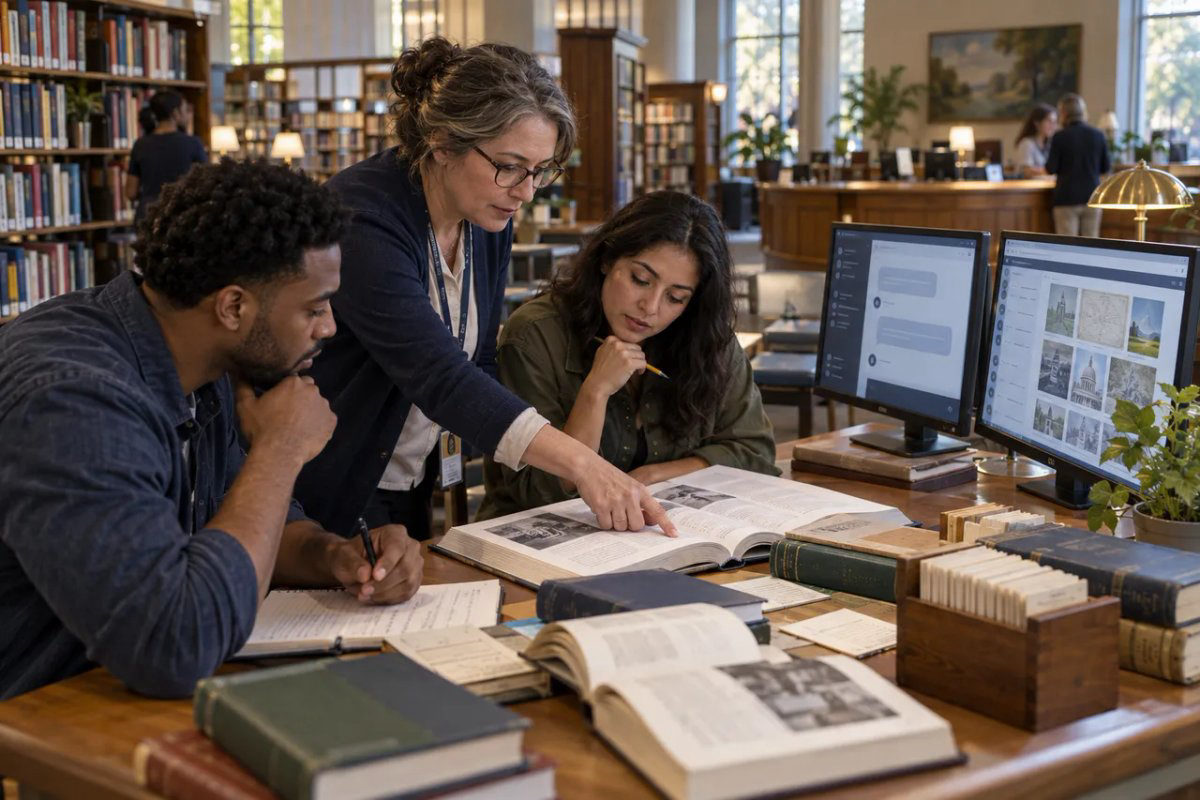
A search box can produce an answer. A librarian can help someone ask whether it is the right answer, where it came from and what to do next.
The need: a place to ask basic questions without being left behind
Public access to AI has a human side. People need clear interfaces, relevant examples and ways to check whether an answer is trustworthy. A website alone does not answer every one of those questions.
Libraries offer a setting in which the learning activity can begin with the person’s actual need: understanding a notice, finding a source or developing a new skill. Public access needs tools, guidance and someone to ask when the next step is unclear.
That requires planning for staff as well as visitors. Instructors need time to practice, materials they can adapt and support when the technology changes. An AI workshop should fit within a library’s wider information and community responsibilities.
AI literacy in San Antonio
An April 17, 2026 Texas State Library and Archives Commission profile describes Kim Grotewold's evolving AI librarian role at Texas A&M University–San Antonio. Her work includes staff development and workshops for students and faculty. In one activity, learners compared AI-assisted research suggestions with library databases. The profile describes an approach to instruction, not measured improvements in research ability. Read the state library's profile.
Public libraries are also building capacity. A July 2026 New Jersey announcement describes a five-library pilot in which staff receive training and then offer community workshops. Its announcement establishes the program's intended design, not its final results. Read the New Jersey initiative.
Build workshops around work people recognize
For example, an introductory workshop would compare an AI summary of a public notice with the original. Participants would check the date, eligibility language and contact information, then discuss which details the summary omitted. The exercise would teach a repeatable habit without requiring personal information.
A research session would begin with a question and compare suggested sources with actual books, databases or official records. Participants would locate a cited passage themselves and identify when a reference cannot be found. The objective would be a better research process, not simply a faster answer.
A creative session would use material the library has permission to share. Learners would develop a short community-history presentation, check quotations and distinguish documented events from invented dialogue. An advanced workshop would compare outputs from a small local model and a hosted service, explaining what each arrangement means for devices, access and information handling.
Keep the entry points flexible
Some visitors will want a single demonstration; others will return for a course. Printed exercises, accessible formats and small-group support would let the program accommodate different levels of confidence. Participants should also be able to stop or continue without making an unnecessary personal account.
Staff would need guidance on which information belongs in a public demonstration and how to help someone with a sensitive task through an appropriate channel. Participation counts would be useful, but understanding what visitors can do after the session would matter more.
Measure capability beyond the workshop
Evaluation should ask participants to locate an original source, recognize an invented reference and complete a new task after the session. Libraries should track which groups are still not being reached and what support instructors need.
American Super Intelligence proposes public AI that people can understand, question and use with local support. It does not imply that Grotewold, her university or these library organizations have joined American Super Intelligence.
How Liberty will support a library-led learning network
LibertyGPT will give library visitors a public assistant for questions, research preparation and guided practice. Liberty OSS will add models for supervised local workshops and institution-managed tools, with documented releases that instructors can examine and adapt.
the program’s education program will develop reusable lessons, instructor preparation and accessible materials. Those resources can reduce the amount each institution has to invent while leaving librarians room to choose examples that fit their community. Devices, connectivity and staff time will need to be funded alongside model access.
The contribution will be a lasting public learning resource. A visitor will have a place to begin, a librarian will have tools and support for teaching, and both will have ways to question and improve the assistance. That is how model access will become a service people can actually use.